
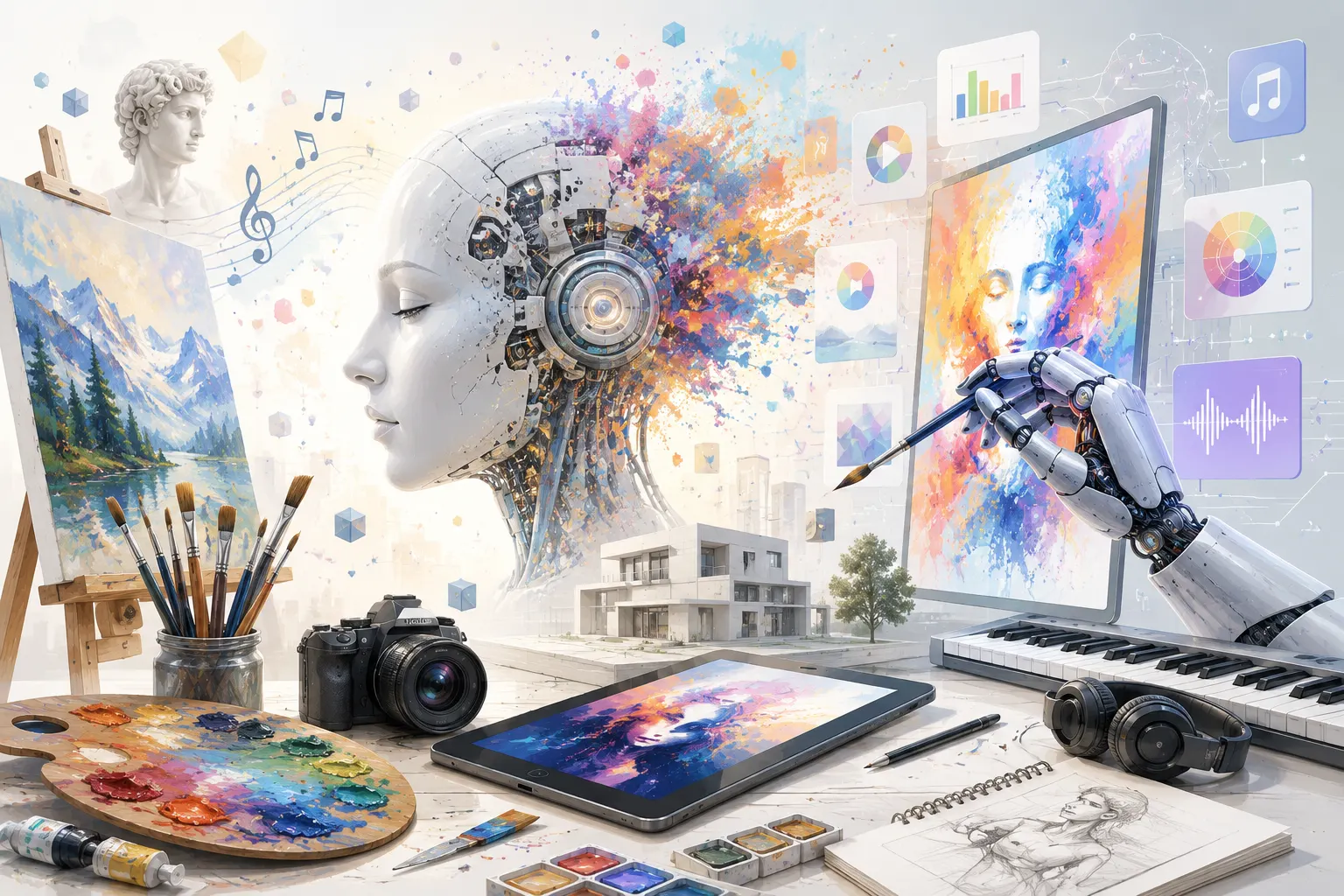
Artificial intelligence and art has become one of the most talked-about topics in recent years. Technologies that once appeared only in science fiction films have now evolved into powerful tools capable of generating paintings, composing music, writing poetry, producing videos, and creating digital designs. While these developments have brought a major transformation to the art world, they have also raised important questions such as “Who is an artist?”, “Is creativity uniquely human?”, and “Can artificial intelligence truly create art?”
The meeting of technology and art is not new. The invention of the camera, the rise of digital drawing programs, and the development of 3D modeling software all sparked similar debates. However, artificial intelligence occupies a different position from earlier technologies because it goes beyond being a simple tool and actively participates in the creative process.
So, is the relationship between artificial intelligence and art really the beginning of a new era, or is it simply the latest stage in the natural evolution of art history? The answer depends not only on the possibilities offered by technology but also on how we understand the essence of art itself.
What Is Artificial Intelligence and Art?
The concept of artificial intelligence and art refers to the use of machine learning and deep learning algorithms in artistic production processes. Artificial intelligence systems can analyze millions of images, texts, music pieces, or videos, learn specific aesthetic patterns, and generate new content based on that knowledge.
Today, with just a few words of input, it is possible to produce oil-painting-style artworks, digital illustrations, 3D character designs, short films, animations, and original music.
This increases the speed of artistic production while also creating new debates about how the creative process itself should be defined.
How Does Artificial Intelligence Create Art?
Many people assume that artificial intelligence imagines or thinks, but in reality, these systems operate through algorithms trained on large datasets.
Artificial intelligence:
Analyzes images.
Learns color relationships.
Studies composition rules.
Evaluates perspective structures.
Identifies common features in art movements.
Interprets user prompts.
Generates new content based on learned patterns.
The resulting work is often not a direct copy of earlier pieces. Instead, it is created through the reinterpretation of visual relationships learned from millions of examples.
For this reason, artificial intelligence output is not random; it is built on mathematical models and probability calculations.
The Historical Development of Artificial Intelligence and Art
In fact, the relationship between art and technology goes back a long way. The discovery of perspective rules, the development of printing techniques, the invention of the camera, and the emergence of digital art all marked major turning points in art history.
In the 1960s, computer-assisted art began to emerge, and geometric patterns were produced with the help of algorithms.
In the 1980s, digital graphic software made computers one of the most important tools for artists.
In the 2000s, with the advancement of machine learning, computers moved beyond being simple drawing tools and began creating original compositions by learning aesthetic patterns.
Today, artificial intelligence-assisted art production is used daily by millions of people.
Can Artificial Intelligence Replace Artists?
This is one of the most debated questions.
Artificial intelligence can create technically impressive works. It can balance colors, build compositions, and imitate different art movements.
However, art is not only about technical skill.
The elements that make a work of art valuable include:
lived experiences,
cultural background,
personal expression,
social criticism,
emotional depth,
aesthetic choice,
the artist’s life story,
the purpose of creation.
Artificial intelligence, however, does not possess consciousness. It has no personal experiences, memories, or emotional history.
For this reason, many art historians argue that artificial intelligence is not replacing the artist but rather serving as a powerful creative tool used by the artist.
Artificial Intelligence in Visual Arts
Artificial intelligence has brought major changes especially to the visual arts.
Today, artists use AI-supported systems in areas such as:
digital illustration,
concept design,
character development,
architectural visualization,
fashion design,
poster creation,
product design,
storyboard production,
game design.
These tools save a great deal of time, especially during the idea-development stage.
An artist can view dozens of different compositions within minutes and reshape them through their own interpretation.
Artificial Intelligence and Painting
In the field of painting, artificial intelligence has become one of the most striking developments.
Works resembling Impressionism, Surrealism, Cubism, Pop Art, Expressionism, or Minimalism can now be generated.
However, the important point here is not merely that AI imitates appearances, but how the artist uses those outputs.
Many contemporary artists see AI-generated images as a starting point and transform them further through their own creative vision.
Artificial Intelligence and Digital Art
Digital art has already developed alongside computer technologies.
For this reason, artificial intelligence is often seen as a natural part of the evolution of digital art.
NFT projects, interactive installations, augmented reality applications, and virtual exhibitions have become more dynamic thanks to AI.
Viewers are not only looking at artworks; in some cases, they can also interact with them.
How Is Artificial Intelligence Changing Art Education?
Art education is also being significantly influenced by artificial intelligence.
Students can see different composition alternatives within seconds, experiment with colors, and conduct visual analyses related to art history.
In addition, during the learning process, the following can be examined more quickly:
perspective studies,
anatomy drawings,
light and shadow analysis,
color harmony,
composition planning.
However, educators emphasize the importance of developing creative thinking skills rather than relying only on ready-made content.
Artificial Intelligence and Copyright
When discussing artificial intelligence and art, one of the most important issues is copyright.
Artificial intelligence systems are trained on large datasets.
The way works included in these datasets are used sometimes leads to legal debates.
In particular, the use of living artists’ works as training data raises ethical and legal concerns.
International regulations in this area are expected to increase in the coming years.
Ethical Debates in AI Art
Technological progress brings not only opportunities but also ethical questions.
For example:
Who is the artist in AI-generated works?
How important is human contribution in the production process?
Are training datasets used with permission?
Where does the line between imitation and inspiration begin?
How should AI-generated works be labeled?
There are still no definitive answers to these questions.
However, the art world, legal experts, and technology companies are working toward shared solutions.
Is Artificial Intelligence a Threat to Artists?
Some artists believe that artificial intelligence threatens their profession.
Others see it as a new creative tool.
In the past, the camera did not completely eliminate painters.
Similarly, digital drawing programs did not destroy traditional painting.
Today, many artists use both traditional techniques and digital tools together.
Artificial intelligence will likely become one of the natural tools of artistic production as well.
Artificial Intelligence and Human Creativity
Creativity is not only about producing a new image.
Solving problems in different ways, creating meaning, building cultural context, and developing an emotional connection with the audience are also part of creativity.
The human mind is shaped by lived experience.
Artificial intelligence, on the other hand, learns from datasets.
Therefore, these two forms of production do not have to be alternatives to one another.
On the contrary, when they work together, they can produce stronger results.
The Future of Artificial Intelligence and Art
In the coming years, AI-assisted art production is expected to become even more widespread.
In particular, major developments are anticipated in areas such as:
personalized artworks,
interactive exhibitions,
virtual museums,
augmented reality applications,
3D art production,
real-time performance art.
Artists will be able to speed up their creative processes, while audiences will experience deeper interaction with artworks.
Advantages of Artificial Intelligence and Art
The main contributions of artificial intelligence to the art world include:
It speeds up the production process.
It makes idea generation easier.
It offers different composition options.
It reduces the cost of experimentation.
It supports the learning process.
It helps overcome creative blocks.
It simplifies digital art production.
It enables new forms of expression.
Disadvantages of Artificial Intelligence and Art
However, there are also some risks.
Copyright issues
Originality debates
Overdependence on ready-made production
Traditional skills being pushed aside
Ethical uncertainty
Data security concerns
Confusion in the art market
For this reason, artificial intelligence must be used consciously and responsibly.
Common Misconceptions About Artificial Intelligence and Art
There are several widespread misconceptions in society.
“Artificial intelligence will completely replace artists.”
In reality, many experts view AI as a powerful tool that supports the creative process.
“Artificial intelligence thinks.”
Artificial intelligence does not possess consciousness. It performs probability calculations based on learned patterns.
“Anyone can become an artist with artificial intelligence.”
Producing high-quality work still requires knowledge of composition, art history, aesthetic judgment, and proper direction.
Conclusion
Artificial intelligence and art is not only a technological innovation but also an important transformation that encourages us to rethink the concept of art. Today, artificial intelligence is a powerful assistant that speeds up artists’ workflows, helps generate new ideas, and offers different forms of expression. At the same time, human experience, emotion, cultural background, and a unique perspective remain at the center of art.
In the coming years, hybrid production models in which artificial intelligence and human creativity work together are expected to become more common. Therefore, the art of the future seems likely to be built not on competition between humans and technology, but on collaboration.
La ludopatía responsable consiste en un conjunto de principios el cual pretende conservar el control respecto a las apuestas así como prevenir los problemas relacionados con el juego.
Incluye definir límites personales antes de participar, así como identificar los indicios de una posible adicción.
https://www.apkfiles.com/apk-622658/descargar-mobcash-apk-oficial-gesti-n-de-caja-m-vi
Igualmente, promueve elecciones conscientes y busca que el entretenimiento continúe siendo la finalidad principal al el juego.
Para decirlo de otro modo, este enfoque facilita a las personas a mantener el dominio sobre su comportamiento así como a vivir el juego de forma equilibrada.