
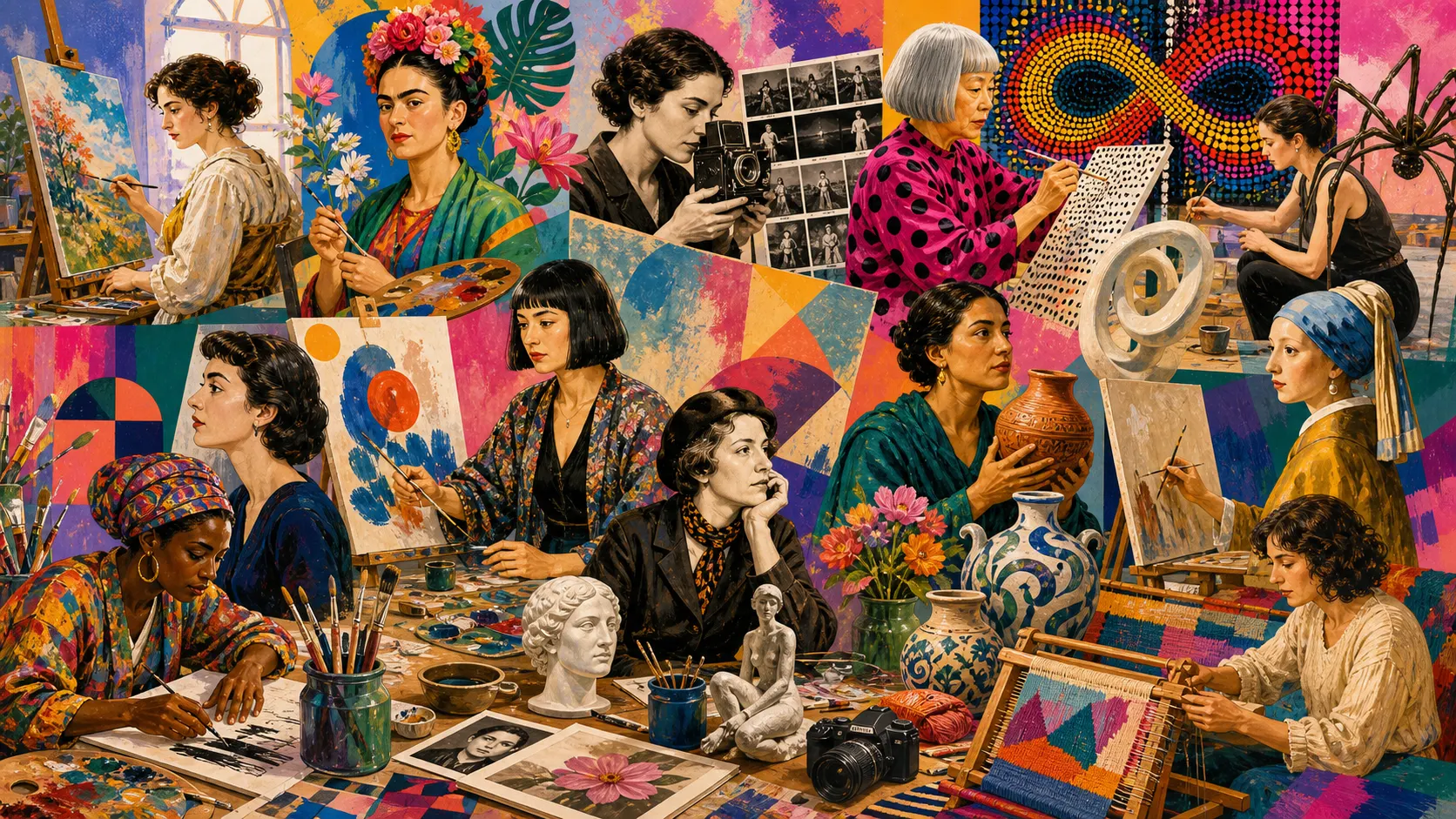
For many years, art history was largely told through the achievements of male artists. However, numerous women artists who remained in the shadows of this narrative—or were not given the recognition they deserved—played a crucial role in transforming the course of art. Working across painting, sculpture, photography, performance art, textiles, and contemporary practices, these artists not only created works of remarkable aesthetic value but also brought issues such as gender, identity, the body, freedom, and representation into the center of artistic discourse.
Women artists who left a mark on art history are powerful figures who continued creating despite the limitations of their times, challenged conventions, and inspired future generations. Some struggled to gain admission to academies, others found it difficult to achieve the same visibility as their male counterparts, and some directly changed the rules of the art world. Today, their legacy allows us to read art history in a richer and more inclusive way.
1. Artemisia Gentileschi
Born in Rome in 1593, Artemisia Gentileschi was one of the most important painters of the Baroque period. Influenced by Caravaggio’s dramatic use of light and shadow, she became known for her powerful depictions of female figures. Her masterpiece, Judith Slaying Holofernes, is considered one of the most striking paintings in art history. Achieving international success at a time when women faced significant barriers in the art world, Gentileschi became not only a celebrated painter but also a symbol for women artists.
2. Sofonisba Anguissola
Born in Italy in 1532, Sofonisba Anguissola was one of the most successful female painters of the Renaissance. Renowned for her portraits, she served at the court of King Philip II of Spain. Her ability to capture personality and emotion in her subjects set her apart. Admired by Michelangelo himself, Anguissola became an important role model for future generations of women artists.
3. Élisabeth Vigée Le Brun
French painter Élisabeth Vigée Le Brun, born in 1755, was one of the leading portrait artists of 18th-century Europe. She is best known as the official portraitist of Queen Marie Antoinette. Throughout her career, she produced more than 600 portraits and numerous landscapes. Despite being forced to leave France during the French Revolution, she built an international career by working across Europe.
4. Rosa Bonheur
Born in 1822, Rosa Bonheur was a French artist celebrated for her realistic animal paintings. She conducted extensive studies of animal anatomy by observing livestock on farms and in slaughterhouses. Her masterpiece, The Horse Fair, demonstrates her technical skill and keen observational abilities. Bonheur was one of the few women artists of her era to achieve significant commercial success during her lifetime.
5. Berthe Morisot
A founding member of the Impressionist movement, Berthe Morisot was born in France in 1841. She worked alongside artists such as Claude Monet, Edgar Degas, and Pierre-Auguste Renoir. Morisot painted scenes of domestic life, family relationships, and interiors using light brushstrokes and luminous colors. Today, she is recognized as one of the most important figures of Impressionism.
6. Mary Cassatt
Born in the United States in 1844, Mary Cassatt spent much of her career in France. Closely associated with the Impressionists, she became known for her depictions of mothers and children. Through her sensitive portrayals of women’s social and private lives, Cassatt contributed significantly to increasing the visibility of women in the art world.
7. Hilma af Klint
Born in Sweden in 1862, Hilma af Klint is now regarded as one of the pioneers of abstract art. For many years, her work remained largely unknown to the public. She created large-scale compositions featuring geometric forms, symbols, and spiritual themes. The posthumous discovery of her work has led to a major reassessment of art history.
8. Georgia O’Keeffe
Born in 1887, Georgia O’Keeffe is one of the most influential figures in modern American art. She is known for her large-scale flower paintings, New Mexico desert landscapes, and abstract forms. By interpreting nature through a unique perspective, O’Keeffe played a key role in the development of American Modernism. Today, her works are displayed in some of the world’s most prestigious museums.
9. Frida Kahlo
Born in Mexico in 1907, Frida Kahlo is one of the most recognizable women artists in history. The physical pain and health challenges she endured after a severe bus accident became central themes in her work. Through her self-portraits, Kahlo explored identity, the body, love, suffering, and cultural heritage. Her vivid colors and symbolic imagery established a distinctive visual language, making her a leading figure in feminist art.
10. Lee Krasner
Born in New York in 1908, Lee Krasner was an important representative of Abstract Expressionism. Known for her bold use of color and energetic compositions, she spent many years overshadowed by her husband, Jackson Pollock. Today, however, Krasner is recognized as a major artist in her own right, with works featured in leading museums worldwide.
11. Louise Bourgeois
Born in Paris in 1911, Louise Bourgeois was one of the most influential sculptors and installation artists of the modern era. Childhood memories, family relationships, and psychological trauma formed the foundation of her work. Best known for her monumental spider sculptures, Bourgeois remains one of the most powerful figures in contemporary art.
12. Yayoi Kusama
Born in 1929, Japanese artist Yayoi Kusama gained worldwide fame for her polka-dot patterns and immersive Infinity Rooms. Transforming the visual hallucinations she experienced since childhood into art, Kusama developed a unique aesthetic based on repetition and obsession. She is now one of the most celebrated living contemporary artists.
13. Cindy Sherman
Born in 1954, American artist Cindy Sherman revolutionized photography through her conceptual work. By transforming herself into various characters, she examines issues of gender, media representation, and identity. Her Untitled Film Stills series is considered one of the most influential projects in contemporary photography.
14. Barbara Kruger
Born in 1945, Barbara Kruger brought her background in graphic design into her artistic practice. Through bold text layered over black-and-white photographs, she critiques consumer culture, media manipulation, and gender roles. Her work Your Body Is a Battleground has become an iconic image in feminist art.
15. Marina Abramović
Born in Serbia in 1946, Marina Abramović is one of the pioneers of performance art. She is known for works that test physical and psychological limits. Her performance The Artist Is Present, presented at the Museum of Modern Art in New York, became one of the most discussed projects in contemporary art history.
16. Tracey Emin
Born in 1963, British artist Tracey Emin is known for placing her personal life at the center of her work. Her installation My Bed sparked widespread debate in the contemporary art world. Emin openly explores themes such as love, loneliness, trauma, and female experience with honesty and vulnerability.
17. Jenny Holzer
Born in 1950, Jenny Holzer is one of the leading figures in text-based art. She is known for using LED displays and projections in public spaces. Through concise and provocative statements, Holzer combines art with political and social critique.
18. Shirin Neshat
Born in Iran in 1957, Shirin Neshat gained international recognition through her photography and video works. Her art addresses themes such as female identity, exile, cultural conflict, and political oppression. Through striking black-and-white imagery and poetic storytelling, she has become one of the most influential voices in contemporary art.
19. Kara Walker
Born in 1969, American artist Kara Walker is known for works that confront racism, slavery, and historical memory. Her large-scale silhouette installations are particularly notable. By offering a critical perspective on America’s past, Walker has secured an important place in contemporary art.
20. Füreya Koral
Born in Istanbul in 1910, Füreya Koral is considered one of Turkey’s first contemporary ceramic artists. She transformed ceramics from a decorative craft into a significant form of modern artistic expression. Her large-scale ceramic murals created for public buildings hold an important place in Turkish art history.
The Importance of Women Artists in Art History
The significance of women artists in art history extends beyond the works they created. They also fought for visibility within art institutions, academies, and galleries that were often dominated by men. Their efforts have contributed to a more inclusive and diverse understanding of art history today.
Women artists expanded the scope of artistic expression by addressing themes such as the body, identity, family, social pressure, labor, memory, and freedom from unique perspectives. Studying their work helps us understand not only artistic aesthetics but also the evolving values and ideas of society.
Conclusion
The 20 women artists who left a mark on art history come from different periods and regions, yet they share a common achievement: expanding the boundaries of art. From Artemisia Gentileschi to Frida Kahlo, from Hilma af Klint to Yayoi Kusama, and from Louise Bourgeois to Füreya Koral, these artists created legacies that transcend their own eras.
Learning about these artists allows us to view art history through a broader lens. Art history is not only the story of famous movements and great museums; it is also the story of unheard voices, overlooked contributions, and courageous acts of creativity.
No comments yet. You can leave the first one.