
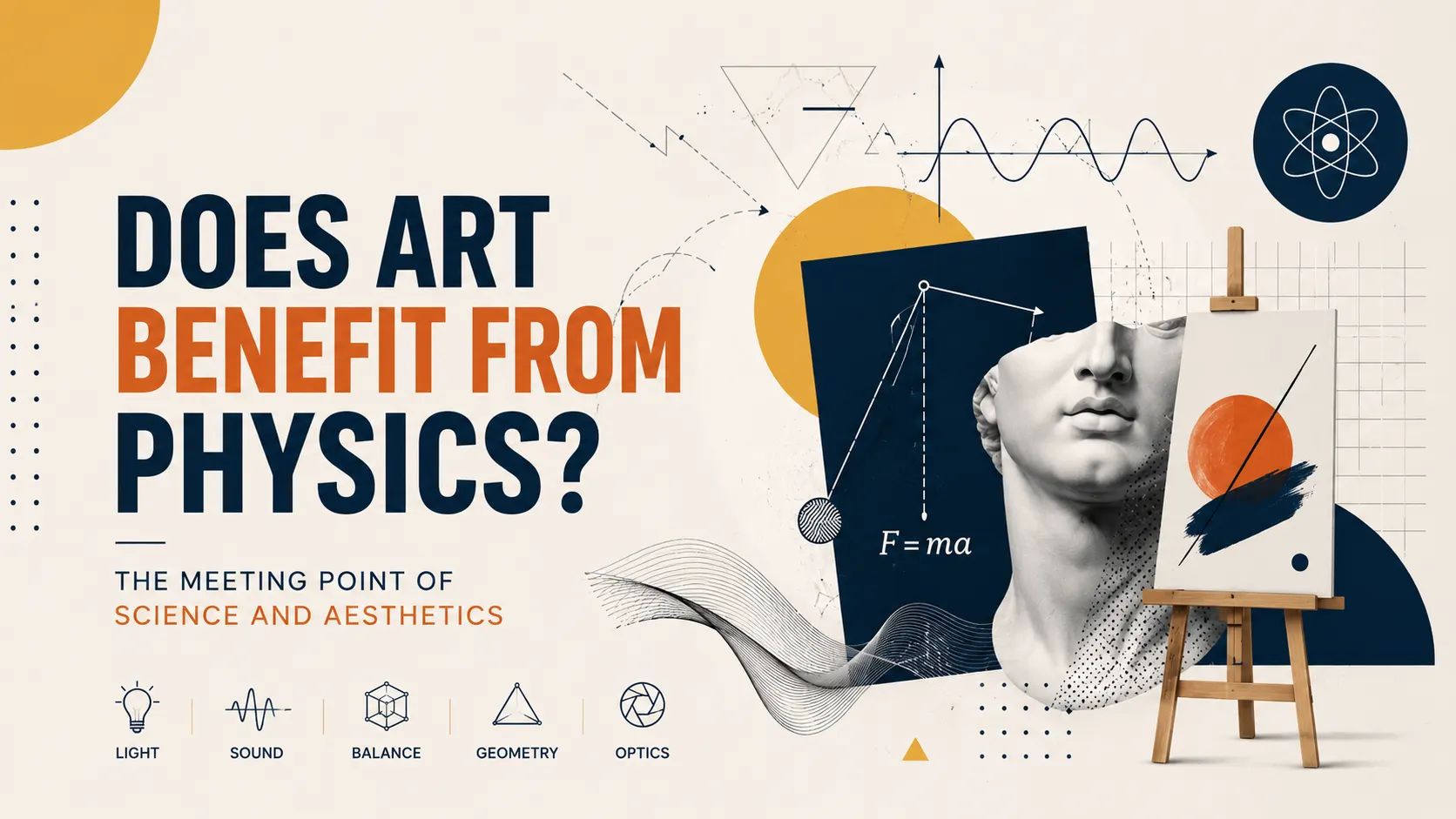
Does art benefit from physics? At first glance, this question may surprise many. Art is generally associated with emotion, imagination, and creativity, while physics is associated with mathematics, experimentation, and scientific principles. However, throughout history, art and physics have never been entirely independent fields. On the contrary, many art forms have directly or indirectly benefited from the principles offered by physics.
Today, the influence of physical principles is clearly visible in many art forms, from painting and architecture to music and cinema. So how exactly does art benefit from physics? How do scientific principles shape aesthetic production? Let's examine the answers to these questions together.
What is the relationship between art and physics?
Art and physics, at first glance, seem to serve different purposes. Art aims to express human emotions and thoughts, while physics seeks to understand the workings of the universe. However, both fields rely on observing the world around us.
A painter, when studying the effect of light on objects, actually utilizes optical physics. A sculptor considers the center of gravity to ensure their work remains balanced. An architect, when designing structures, must take into account the principles of force, load, and balance.
Therefore, there is an invisible but powerful link between art and physics.
How does art benefit from physics?
The influence of physical principles on painting is quite significant. The subjects of light and color, in particular, are directly linked to physics.
When the human eye sees an object, it actually perceives the light reflected from that object. Painters, in order to create realistic works, take into account the direction of light, the formation of shadows, and the interaction of colors with each other.
Artists living during the Renaissance period used knowledge of geometry and optics while developing the rules of perspective. This allowed them to create a sense of three-dimensional depth on two-dimensional surfaces.
Even today, digital artists utilize physics-based methods when using light simulations and shading techniques.
Why is Physics So Important in Architecture?
Architecture is a specialized discipline with both technical and artistic aspects. A building may be aesthetically impressive; however, it cannot remain standing if it does not conform to the laws of physics.
Architects consider many physical factors in the design process:
- Gravity
- Pressure forces
- Wind loads
- Earthquake effects
- Material strength
- Heat and energy transfer
Is Sculpture Subject to the Laws of Physics?
Balance is just as important as aesthetic appeal in a sculpture. The center of gravity plays a critical role, especially in large-scale works.
Sculptors consider the following elements when designing their works:
- Points of balance
- Mass distribution
- Material density
- Durability
- Effect of gravity
Therefore, sculpture has not only an aesthetic but also a physical engineering dimension.
Is there a connection between music and physics?
When we think of music, sounds and emotions usually come to mind. However, sound itself is a physical phenomenon.
Sound is created by the propagation of vibrations through a medium. When a guitar string is struck, the resulting vibrations are transmitted through the air and reach our ears. The pitch, frequency, and intensity of sound can be explained entirely by the laws of physics.
Physics also plays an important role in the design of musical instruments. The body structure of a violin, the length of piano strings, or the diameter of a drum are physical elements that determine the sound characteristics.
Therefore, acoustic physics lies at the heart of the art of music.
How do cinema and photography benefit from physics?
Much of the modern visual arts is inconceivable without physics.
Cameras operate on optical principles. Lenses focus light at a specific point, enabling the formation of an image. Concepts such as focal length, aperture, and light intensity are directly based on physical calculations.
In the film industry, the situation is even more comprehensive. Camera systems, lighting arrangements, sound technologies, and special effects have been developed thanks to knowledge of physics.
Especially in today's computer-aided visual effects, the behavior of light is simulated using mathematical and physical models.
The Relationship Between Digital Art and Physics
With the advancement of technology, digital art has gained significant momentum. Three-dimensional modeling programs, game designs, and animations utilize physics engines.
Thanks to these systems:
- Water moves realistically.
- Fabrics ripple naturally.
- Objects react accurately when they collide.
- Light and shadows appear lifelike.
Although artists don't have to perform physical calculations directly, complex physics algorithms lie behind the tools they use.
Who are the historical figures who combined science and art?
Throughout history, many individuals have combined art and science. One of the best-known examples is Leonardo da Vinci.
Da Vinci was not only a painter but also an engineer, anatomist, and inventor. By studying the human body, light, and movement, he imbued his works of art with scientific accuracy.
His work demonstrates that art and science are, in fact, complementary fields.
Will the relationship between art and physics grow even stronger in the future?
With the development of artificial intelligence, virtual reality, and augmented reality technologies, the relationship between art and physics is deepening.
Today, artists can design experiences previously impossible thanks to light simulations, particle systems, and physics engines. In the future, quantum technologies, holographic systems, and new imaging methods may open up new horizons for the art world.
These developments show that art is gaining importance not only for its emotional aspect but also for its scientific aspect.
Conclusion
Does art benefit from physics? Absolutely yes. From painting to architecture, music to sculpture, photography to digital design, many art forms utilize the principles offered by physics. Concepts such as light, color, sound, motion, balance, and energy play a significant role in the creation of works of art.
While art represents the human imagination, physics explains how the universe works. When these two fields come together, impressive results emerge, both aesthetically and technically. Therefore, art and physics are not distant from each other; on the contrary, they can be considered two powerful disciplines that mutually reinforce each other.





No comments yet. You can leave the first one.